
How do you deal with a narcissistic parent?
I asked our community this question, and the responses were unbelievable.
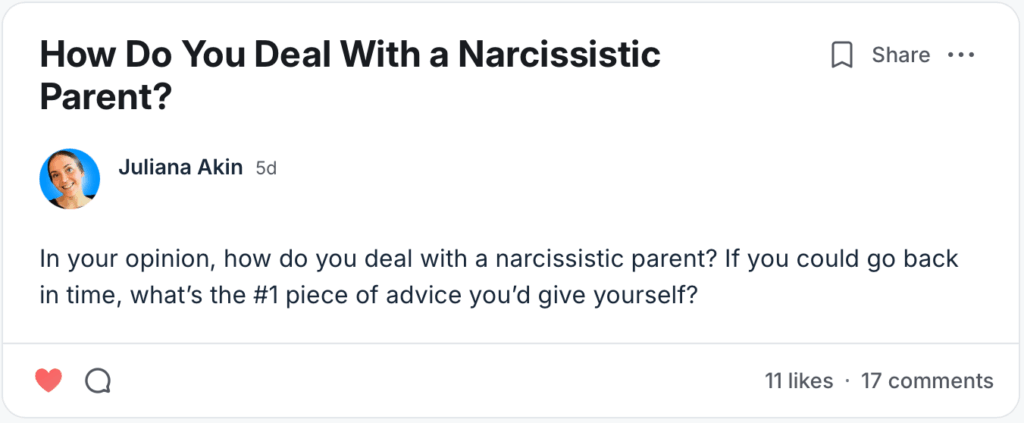
It was like being handed a map by people who’ve already escaped the maze.
So I took all the responses and grouped them into ten strategies to share with you.
I’ve also created “how-to” articles for each one, and I’ll give them to you at the end.
The first strategy is managing your expectations.
This means accepting that your parent can’t be the person you need them to be. It’s about letting go of the hope for a “normal,” healthy, or mutually supportive relationship.
The second strategy is setting boundaries.
This means making conscious and well-informed decisions that prioritize the well-being of you and the people close to you over your narcissistic parent’s expectations and narrative.
The third strategy is mastering high-conflict communication.
This means learning to communicate in a strategic way that de-escalates conflict and prevents you from being pulled into the manipulative games narcissistic parents play.
The fourth strategy is taking control of your triggers.
This means identifying the specific “buttons” your parent or their supporters may push — and having a plan for managing your response if or when it happens.
The fifth strategy is choosing low or no contact.
This means deciding how much contact you can have with your parent, whether daily, a few times a year, or none at all, without compromising the well-being of you and those around you.
The sixth strategy is becoming financially independent.
This means removing any financial ties that allow your parent to control your life, such as co-signed loans, joint bank accounts, rent, tuition, insurance, phone plans, etc.
The seventh strategy is building a support system.
This means actively seeking out and nurturing relationships with people who provide consistent validation, emotional support, and a healthy, realistic perspective.
The eighth strategy is creating a crisis plan.
This means creating a pre-determined set of actions for crises that may arise with your parent, things like an unexpected visit, a sudden illness, or a death in the family.
The ninth strategy is reparenting.
This means identifying the developmental needs that went unmet in your childhood and learning how to meet those needs for yourself now.
The tenth strategy is working with a mental health professional.
This means engaging with a professional who specializes in narcissistic abuse and can provide a safe, neutral, and confidential space for you to move through your healing journey.
Final Thoughts
So there you have it — ten strategies for dealing with a narcissistic parent.
If you’d like to learn how to do each one, I’ve started creating a “how-to” series for them, and they’ll be on this page when the articles come out:
10 Strategies for Dealing with a Narcissistic Parent
Thank you for reading today’s episode the Unfilteredd: Narcissistic Families podcast.
If this was helpful and you’d like to read the next one, please subscribe to our newsletter — we’ll let you know as soon as the next episode is released.
My name is Juliana Akin — your guide to overcoming the effects of narcissistic abuse — and I can’t wait to connect with you in a future episode.
Subscribe to Our Newsletter
We’ll send you new episodes of the Unfilteredd: Narcissistic Families podcast 1–2 times a week, along with updates and insights to help you heal and move forward with your life.
About the Author

Hi, it’s Juliana!
I’m a founder of Unfilteredd and we help you overcome the effects of narcissistic abuse so you can heal and move forward with your life.