
If you want to heal, you have to get your narcissistic ex out of your head.
You don’t have to stop thinking about them straight away.
But you do have to move them out of the driver’s seat — or they’ll crash the car into your mental health, physical health, financial health, and even your relationships.
So in this article, I’m going to teach you a three-step framework that people we work with use to stop ruminating — and show you how it works so you can use it too.

If we’re just meeting — my name is Juliana Akin. I’m a founder of Unfilteredd, and we help you overcome the effects of narcissistic abuse so you can heal and move forward with your life.
What Is Rumination?
Alright, before I get into the steps, let’s just quickly talk about what rumination actually is.
Rumination is when you think the same thoughts in a repetitive loop.
There are two main types, the first is brooding.
This is a repetitive focus on negative emotions, thoughts, experiences, and perceived failures.
It’s unwanted, distressing, and often feels compulsive — like you can’t stop, even if you want to.
The second is reflective.
This is an analytical thought process aimed at understanding a situation or solving a problem.
It may involve painful thoughts, but it’s intentional and usually helps you move forward.
If you’ve experienced narcissistic abuse, you’re most likely dealing with brooding rumination.
Step 1: Recognize When You’re Brooding
The first step of this framework is recognizing when you’re brooding.
But this can be hard — because sometimes, especially if you’ve been stuck in your head for a while, you don’t even realize it’s happening.
You just zone out and lose track of time.
If that sounds like you, try making a list of what your body does when you’re ruminating.
For example, you might notice things like:
- Rocking back and forth
- Fidgeting
- Your heart racing
- Or even getting a headache
These are often your body’s way of saying, “Hey, you’re spiraling.”
And the more familiar you get with your own signs, the easier it becomes to recognize when you’re ruminating.
Once you notice it’s happening, you can figure out whether it’s brooding or reflective by asking yourself these three questions:
- “Do I feel more grounded after thinking this?”
- “Am I thinking about this in a clear and constructive way?”
- “Is this helping me move forward?”
Answering “no” to any one of these is a strong sign of brooding.
But, I want to pause here for a moment because the second and third steps in this framework actually happen at the same time.
But I think the most helpful path forward is to explain each of them individually so you understand what you need to do.
Then I’ll share the strategies the people we work with used to move through these two steps, so you can also learn how to do them.
Step 2: Redirect Brooding Rumination Into Reflection
The second step of this framework is redirecting the brooding rumination into reflection.
In other words, instead of trying to shut the thought down, you guide it somewhere useful.
Step 3: Find Resolution
The third step of this framework is finding resolution.
This means giving your brain what it needs to put an end to the rumination.
To understand how this works, think of rumination like getting to the end of a puzzle — and reaching for the final piece… only to realize it’s missing.
You start searching everywhere — under the table, in the box again, retracing every step — convinced that if you just look hard enough, the piece will turn up.
But it never does.
And that’s what keeps you stuck — not because there’s something wrong with you, but because your brain is trying to finish a puzzle it doesn’t have all the pieces for.
So, it’s up to you to find that missing piece — whether it’s clarity, closure, validation, or something else — so your brain can complete the puzzle… and finally let the rumination go.
But this is much easier said than done — because brooding doesn’t always look the same.
It can, and often does, show up in many different ways depending on your experience with narcissistic abuse and where you are in your healing journey.
So unfortunately, a strategy that works for one type of brooding likely won’t work for another.
Examples of People Overcoming Rumination
And I didn’t want to just leave you hanging here, so my team and I sent out a survey to our community asking about the rumination they’ve experienced.
Then we organized the responses we received into six groups, based on the thought patterns people described:
- Self-Doubt
- Lack of Understanding
- The Future
- Self-Blame
- What If
- And Positive Memories
My plan for the rest of this article is to walk you through each group, sharing the strategies the people we work with use to stop ruminating — so you can learn how to use them too.
Group 1: Self-Doubt
This is when you question your own memory, perception, or understanding of what happened.
For example, you might have thoughts like:
- “Maybe I misread the whole situation.”
- “Was it really abuse?”
- “I don’t know what’s true anymore.”
What’s happening here is your brain is trying to figure out if what you experienced was real.
So the missing puzzle piece is self-validation — your brain needs to feel confident about what happened, so it can stop second-guessing itself and start moving forward.
A woman we work with began doing this by fact-checking her thoughts.
She grabbed a notebook and divided the page into three sections labeled:
“Thought,” “What I Know,” and “What I Don’t Know.”
In the first section, under Thought, she wrote down what she’d been ruminating about:
“Maybe he’s not a narcissist.”
In the second section, under What I Know, she listed everything she knew about the situation:
- “He blamed me for things I didn’t do.”
- “He cheated multiple times.”
- “He screamed at me when I tried to set boundaries.”
- “He refused to take responsibility for his actions.”
- “He stole a lot of money from me.”
In the third section, under What I Don’t Know, she wrote:
“I don’t know if he meets the clinical criteria for narcissistic personality disorder.”

Then she used all this information to form a grounded conclusion, which was:
I don’t know if he has narcissistic personality disorder, but I do know he has narcissistic traits.
It doesn’t matter whether he’s a full-blown narcissist or not — what matters is that he’s emotionally abusive, refuses to change, and is unsafe to be around.
I don’t need a diagnosis to protect myself from him.
This was the second and third part of the framework, because instead of spinning in uncertainty, she turned the thought into reflection by separating what she knew from what she didn’t.
Then, by using that information to form a grounded conclusion — she gave her brain the validation it needed to stop second-guessing itself and start moving forward.
Group 2: Lack of Understanding
This is when you try to make sense of your ex’s behavior or the relationship.
For example, you might have thoughts like:
- “Why did they do this to me?”
- “Did they ever really love me?”
- “How could they move on so fast?”
What’s happening here is your brain keeps asking the same questions, hoping that if it can just understand why, the pain will finally go away.
So, the missing puzzle piece is answers — your brain wants an explanation it can settle on, so it doesn’t have to keep searching.
To do this, a man we’re working with uses an exercise called Road Spikes.
Let me explain…
A thought he ruminates about is: “Why did she treat me like that?”
So, we helped him research narcissistic behavior, he took detailed notes about what he learned and saved everything in a folder on his phone.
Now, when that thought comes up, instead of ruminating about it, he opens his phone and reads the grounded, well-researched explanation he came up with.
This is the second and third steps of the framework — because he took the brooding thought and redirected it into reflection by researching narcissistic behavior.
By revisiting that explanation when the thought returns, he gives his brain the answer it needs to put an end to the rumination.
And we call this exercise Road Spikes because when your brain starts speeding down the road toward rumination, having a grounded, well-researched answer you can turn to is like when police officers lay spikes in the road to stop a speeding car.
The answer pops your brain’s tires — and forces it to come to a stop.
Group 3: The Future
This is when you ruminate about the future you expected to have with them, but didn’t get.
For example, you might have thoughts like:
- “I thought we were going to grow old together.”
- “We were supposed to buy a house and settle down next year.”
- Or “I thought we’d take that trip to Italy — we talked about it for years.”
What’s happening here is your brain hasn’t fully accepted that this future you thought you’d have with them is gone — so it keeps revisiting it, trying to hold on.
The missing puzzle piece is acceptance — your brain needs to fully register that this future isn’t going to happen, so it can let go and begin the grieving process.
To do this, a woman we’re working with wrote out the future she expected to have with her ex, and then next to it, a clear reason why it wasn’t going to happen.
For example, she thought she’d start a family with him.
But when the relationship ended, she discovered he had secretly gotten a vasectomy behind her back — and had been living a double life with another woman.
So, next to that expected future, she wrote:
“This future isn’t possible because he never intended to start a family with me. He made choices behind my back that destroyed that possibility.
It’s natural to feel sad and to grieve the life I thought we’d have — but I can’t keep holding on to something that was never going to happen.”

This was the second and third steps of the framework — because instead of clinging to the future, she redirected the rumination into reflection by facing the truth of why it couldn’t happen.
That strength, honesty, and bravery is what opened the door to the acceptance her brain needed to stop ruminating and begin the grieving process.
Group 4: Self-Blame
This is when you blame yourself for what you did or didn’t do.
For example, you might catch yourself thinking things like:
- “Why didn’t I trust my gut?”
- “I let them treat me that way — that’s on me.”
- “I stayed way longer than I should have.”
What’s happening here is your brain is trying to regain a sense of safety.
If it can convince you that you’re to blame for something you did or didn’t do, it creates the illusion that you had power over what happened.
And that illusion can feel safer than facing how powerless or blindsided you really were.
This type of rumination is especially tough, because sometimes, it has a point.
Maybe you could have set stronger boundaries.
Maybe you didn’t leave when you had the chance.
Maybe you should have handled things differently.
So the missing puzzle pieces here are acceptance of what was actually possible for you at the time — and compassion for the version of you who was doing the best they could.
To do this, a woman we’re working with likes to challenge the self-blame.
The first time she tried this, she grabbed a piece of paper and created two sections.
On the left, she wrote:
“I should’ve left the first time he screamed at me.”
On the right, she challenged it by answering this question:
“At that time — with what I knew, what I believed, and where I was emotionally — what would have actually been possible for me to do?”

She worked through this question with the mental health professional she’s seeing, going back and forth until she landed on the most honest answer she could.
I’m paraphrasing a bit here, but the final answer was:
“I didn’t see it as abuse at the time. I thought it was just a rough patch. I was still hoping the relationship would get better, and I didn’t want to give up on someone I loved.”
This was the second and third steps of the framework because challenging the self-blame redirected the brooding rumination into reflection.
And answering what was truly possible for her at the time gave her brain the acceptance and self-compassion it needed to put an end to the rumination.
Group 5: What If
This is when you obsess over how things could have gone differently.
For example:
- “What if I had been more patient?”
- “What if we’d gone to counseling?”
- “What if I hadn’t pushed them away?”
What’s happening here is your brain is trying to ease the pain by imagining a version of the past where everything turned out okay.
So, the missing puzzle piece here is closure.
Your brain needs to understand — on a deep, emotional level — that even the “better version” wouldn’t have changed the outcome, so it can stop searching for one that would.
To do this, a woman we’re working with uses the What If thought she’s stuck on as a journaling prompt.
For example, one prompt she used was:
“What if I had just agreed to move in with him?”
From there, she wrote out the version of events her brain was holding onto — the one where everything worked out the way she wished it had, like:
- He was more present with their son
- They stopped fighting
- He stopped using dating apps
- They spent quality time together
- They renewed their vows
And she finished the exercise with one final question:
“Can a narcissist change?”
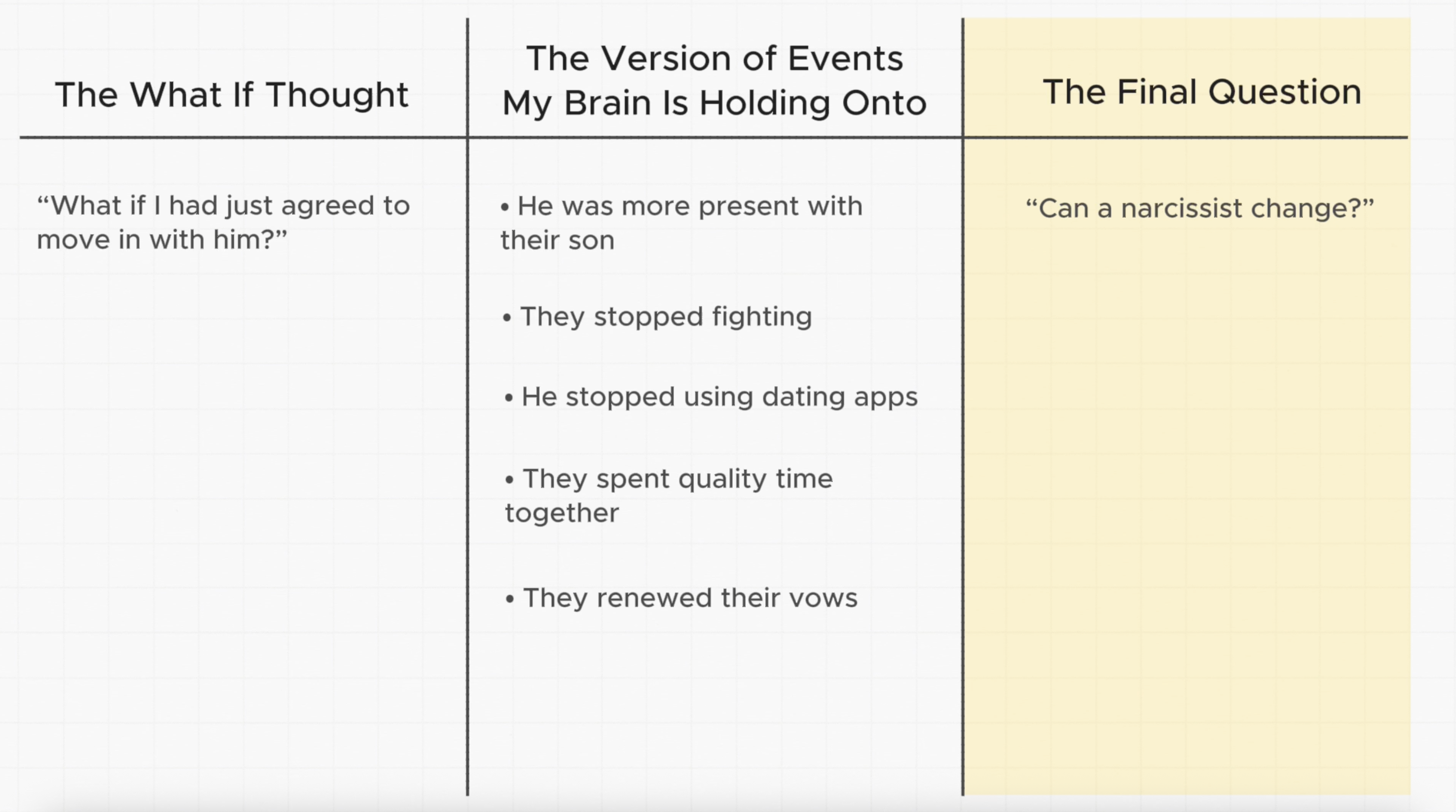
Then she brought it into her next session with the mental health professional she’s working with.
Over the next several sessions, they used what she wrote as a starting point to apply something called the Rubber Band Theory.
If you’re unfamiliar with this term, it’s a fancy way of saying: a narcissist can’t truly change.
You can teach a narcissist to act more empathetic, less entitled, or more emotionally aware. They can learn to say the right things, listen better, or behave more kindly.
But as soon as life puts stress on them — a bad day at work, a rejection, a loss, something not going their way — they snap right back to their original shape, like a rubber band.
This was the second and third steps of the framework — because instead of staying stuck in the what-ifs, she redirected them into reflection by actually playing them out.
And when she acknowledged that better version of him wouldn’t have changed who he is at the core, she gave her brain the closure it needed to put an end to the rumination.
Group 6: Positive Memories
This is when you ruminate about the good moments the two of you had.
For example, you might think about:
- Your wedding
- The first time they said “I love you”
- Or the way they held your hand
What’s happening here is your brain is trying to make sense of how something that felt so good could be part of something that was so harmful.
So the missing puzzle piece is perspective.
Your brain needs a way to acknowledge that while those moments were real to you, the relationship as a whole was not healthy — or it will just keep going in circles.
To do this, a man we’re working with took the positive memory he was ruminating about and wrote it down. Then, he answered the following two questions:
1. “Why does this memory matter to me?”
2. “What else was true about the relationship at that time?”
This was the second and third part of the framework because answering those questions helped him validate the positive memory while also acknowledging how it fit into the larger truth of the relationship.
This redirected the brooding rumination into reflection and gave his brain the perspective it needed to stop spiraling deeper into the memory.
Final Thoughts
Rumination is one of the biggest reasons healing from narcissistic abuse is so hard — but it has a sibling that causes just as much trouble: trauma bonding.
So in the next episode, I’ll share an eight-part process you can use to break the trauma bond with your narcissistic ex — and I’ll link to it below as soon as it’s posted.
Read Now: How to Break a Trauma Bond with Your Narcissistic Ex
Thank you for reading today’s episode of the Unfilteredd: Narcissistic Partners podcast.
If this was helpful and you’d like to read the next one, please subscribe to our newsletter — we’ll let you know as soon as the next episode is released.
My name is Juliana Akin, your guide to overcoming the effects of narcissistic abuse — and I can’t wait to connect with you in a future episode.
Subscribe to Our Newsletter
We’ll send you new episodes of the Unfilteredd: Narcissistic Partners podcast 1–2 times a week, along with updates and insights to help you heal and move forward with your life.
About the Author

Hi, it’s Juliana!
I’m a founder of Unfilteredd and we help you overcome the effects of narcissistic abuse so you can heal and move forward with your life.