
You can’t heal from narcissistic abuse if you don’t break the trauma bond.
As long as that bond exists, part of you will be fighting 24/7 to stay connected to them.
So today, I’m going to walk you through the eight steps you need to take to break that bond.
I’ll show you how people we’ve worked with completed each step.
And I also have a solid resource for you at the end, so be sure to stick around.

If we’re just meeting — my name is Juliana Akin. I’m a founder of Unfilteredd, and we help you overcome the effects of narcissistic abuse so you can heal and move forward with your life.
Step 1: Kill the Fantasy
The first step is killing the fantasy.
This means recognizing that the relationship was not what you hoped or believed it could be — and intentionally letting go of the idea that it could ever become healthy or safe.
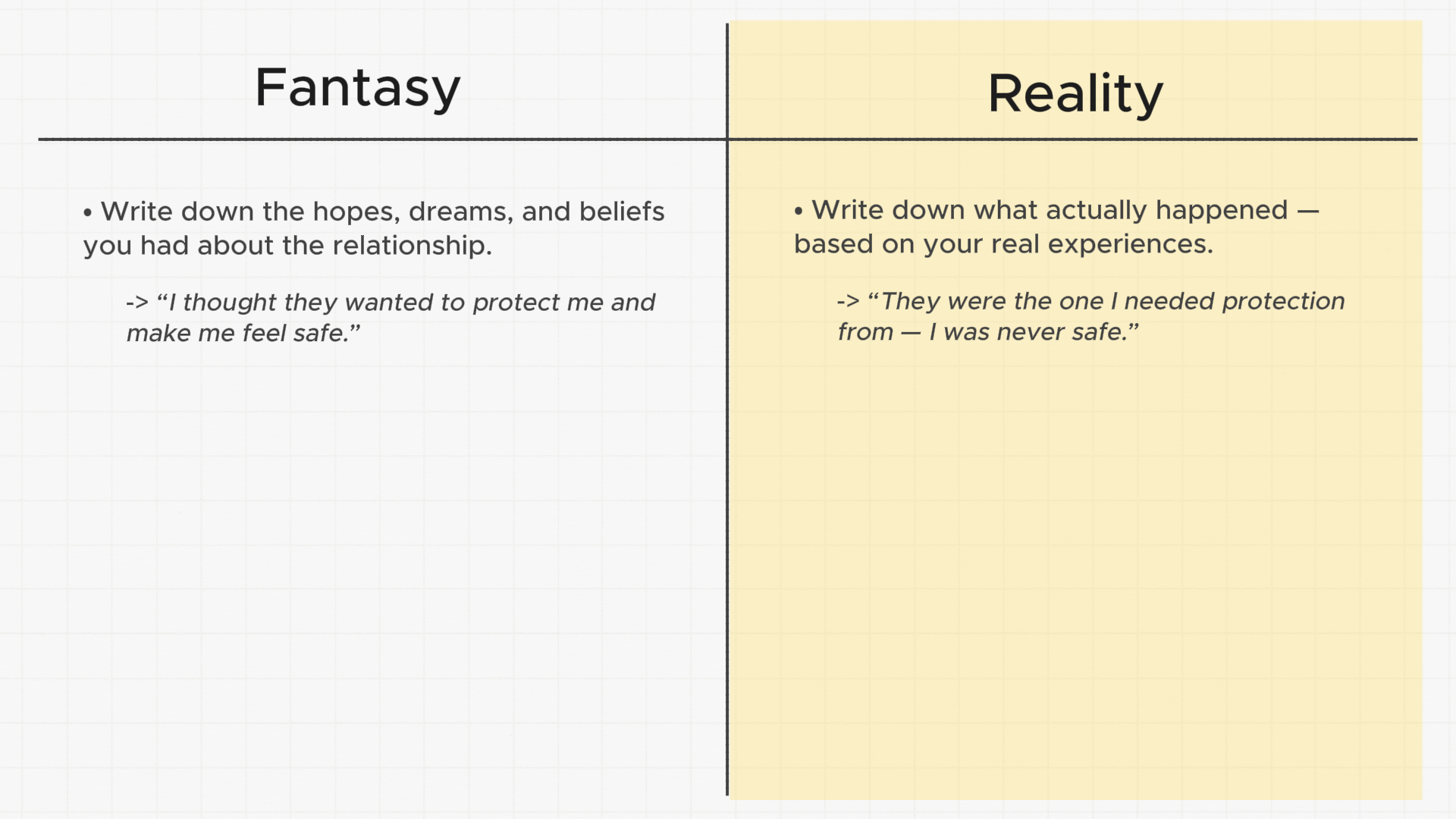
You can do this by making a “Fantasy vs. Reality” chart.
Draw two columns: one labeled Fantasy, the other Reality.
In the Fantasy column, write down the hopes, dreams, and beliefs you had about the relationship.
For example:
“I thought they wanted to protect me and make me feel safe.”
In the Reality column, write down what actually happened — based on your real experiences.
For example:
“They were the one I needed protection from — I was never safe.”
This helps you separate who you wanted them to be from who they actually were — so you can let go of the fantasy and stay grounded in reality.
Step 2: Detox
The second step is detoxing.
This means cutting down how much you see, hear about, or interact with your narcissistic ex — and the people who support them — as much as possible.
There are three main areas to look at when you’re detoxing:
The first is in-person contact.
This means any situation where you could physically see or interact with your ex — like going to the same gym, coffee shop, grocery store, or social events where you know they might be.
The second is digital contact.
This means any way you’re connected through technology — like social media, messaging apps, shared photo albums, or services like Netflix, Spotify, or DoorDash.
The third is third-party contact.
This means people in your life who still have a relationship with your ex — such as mutual friends, family members, neighbors, or even coworkers.

You don’t have to cut everything out at once.
Just focus on detoxing one step at a time — and before you know it, you’ll have the time and space you need for the third step, which is processing the trauma.
Step 3: Process the Trauma
This means actively working through the emotional and psychological effects of narcissistic abuse so that they no longer control how you think, feel, or behave.
There’s no single tactic I can give you for this part.
You’ll most likely need to work with a professional who understands narcissistic abuse.
That’s because there are so many different areas you might need help with.
For example, a man we’re working with needed help with things like:
- Figuring out why he still felt like it was all his fault
- Dealing with the guilt he felt for leaving
- Making sense of why he still missed her sometimes
- Working through the moments that kept replaying in his mind
- And rebuilding trust in his own thoughts, feelings, and decisions
But this process will look different for everyone — so finding a mental health professional who can give you the right guidance and support is a really good idea.
And to help you get started, I’ve got a gift for you.
It’s a free one-on-one session with someone from our team.
You can click here to sign up.
Helping people overcome the effects of narcissistic abuse so they can heal and move forward with their lives is what we do — 24/7, 365.
So if you ever need us, we’re here.
I also want to let you know that in the next episode, I’ll teach you how to find the right professional support after experiencing narcissistic abuse, so keep an eye out for that.
Read Now: How to Find the Right Support After Narcissistic Abuse
Step 4: Grieve
The fourth step is grieving.
This means allowing yourself to feel and process the loss of the relationship.
There are a million different ways you can go about this, but a woman we worked with said that writing a goodbye letter, and letting someone witness it, was the thing that helped her the most.
This letter isn’t something you send.
It’s something you write for yourself.
In it, say goodbye to everything you were holding onto:
- The future you imagined.
- The version of them you believed in.
- The love you hoped they could give you.
- Even the version of yourself that kept trying to make it work.
You can cry.
You can get angry.
You can even break something if you want.
In fact, a couple people in our community have gone to rage rooms and said it helped them a lot more than they expected.
Then, if or when you feel safe, share it with someone you trust.
This person should be someone who can help you stay within your window of tolerance.
I’ll talk more about what this means in the next episode.
But your window of tolerance is the state where you feel steady, present, and grounded.
And as a general rule, it’s where you need to be to make conscious, well-informed decisions that protect and support both you and your loved ones.

Step 5: Cut or Modify the Unknown
The fifth step is cutting or modifying the unknown.
This means identifying and removing the subtle, often-overlooked connections to your ex that still exist in your daily life.
You can do this by asking:
“What small connections to my ex still exist in my day-to-day life?”
And spend as much time as you can thinking about it.
You might notice you still:
- Order pizza every Friday night
- Sleep on “your side” of the bed
- Or wear the hoodie their parents gave you
These things might seem small — even harmless — but they can keep you emotionally tied to your narcissistic ex or the relationship without you even realizing it.
You don’t need to cut or modify everything at once.
Just take it one small step at a time — until you’ve removed all the connections you can.
Step 6: Rebuild Your Identity
The sixth step is rebuilding your identity.
This means taking back ownership of who you are, what you believe, and how you choose to live your life.
A woman we’re working with did this by making a list of all the parts of herself she felt like she had lost — or hadn’t been allowed to explore.
Then she did one small thing each day that helped her reconnect with them.
You can try this too by making separate lists for different parts of your identity, things like your:
- Hobbies
- Traits
- Values
- Boundaries
- Social skills
- Goals
- Interests
- Beliefs
- Routines
- Or Career
For each category, list as many possibilities as you can think of.
For example, under traits, you might write things like thoughtful, creative, and independent.
Under hobbies, you could list painting, lifting, and baking.
Once you have your lists, go through and circle the things that feel most aligned with who you are — or who you want to become.
Then, every morning, choose one of those circled items and find a small way to explore or express it.
For example, if you circled “creativity” as a trait, you might:
- Cook a meal without a recipe
- Write a short poem about your day
- Or make something by hand — like a card, a sketch, or some pottery
At the end of each day, write down what you did, how it felt, and the impact it had on your life.
Continue this process until you have enough data to see clear patterns — this might take anywhere from a few weeks to a few months, depending on how consistent you are and how quickly insights emerge.
Once you have a good amount of data, use that log to guide yourself toward more of what felt good and had a positive impact — and less of what felt bad and had a negative impact on your life.
Step 7: Create a Meaningful Life
The seventh step is creating a meaningful life.
This means intentionally building a life that feels purposeful, fulfilling, and aligned with your deepest values.
A lot of people in our community have done this by asking:
“What does a meaningful life mean to me?”
They thought about areas like:
- Values
- Relationships
- Routines
- Work
- Freedom
- Creativity
- Peace
- Growth
Then, they wrote out their own personal definition.
It could be a sentence, a paragraph, or even a full page.
For example, one person we worked with wrote:
“A meaningful life means waking up with a sense of direction and purpose, spending time with people I love and who love me, and doing work that aligns with my values.”
Once you’ve written your definition, start taking small steps toward that life.
For example:
- If it includes connection → reach out to someone
- If it includes creativity → start making something
- If it includes freedom → step away from something that feels constricting
- If it includes growth → do something challenging
Creating a meaningful life doesn’t happen overnight.
It’s something you build gradually — through small choices that align with who you want to be.
And this exercise is just one of the many ways you can begin doing that.
Step 8: Maintenance and Relapse Prevention
The eighth step is maintenance and relapse prevention.
This means learning how to handle the hard moments — things like cravings to reach out, emotional triggers, trauma symptoms, and unexpected setbacks.
There’s a lot that goes into this, and again, it’s smart to do it with the guidance of a mental health professional — but one of the best places to start is building a coping strategy toolbox.
This is simply a collection of tools, techniques, reminders, and personal practices that help you stay grounded, regulated, and safe when those hard moments hit.
And there are only four steps you need to take to build one.
The first step is to identify what specifically you need to cope with.
For example:
- The urge to check their social media
- The doubt that hits when they say “I miss you” or “I’ve changed”
- Or The emptiness you feel when you wake up and don’t hear from them
The second step is to come up with potential coping strategies for each one.
You can do this by opening up Gemini or ChatGPT and asking:
“Can you give me 10 coping strategies for [insert your struggle]?”
For example:
“Can you give me 10 coping strategies for when I want to check their social media?”
You don’t have to know what works yet — this is just the brainstorming phase.
The third step is to give them a try.
The next time you’re in one of the situations you listed in the first step, try one of the strategies on your list and rate how much it helped you cope on a scale from 1 to 10
But…
Before we move on, I want to say this: if you find a strategy that’s an 8, 9, or 10 out of 10, I highly recommend just continuing to use it for as long as it works.
Quality over quantity is always a safe bet when it comes to coping.
The fourth step is to build your toolbox.
Save the ones with the highest ratings in the notes app on your phone, a journal, or even a sticky note on your wall — anywhere that’s easy to find when you need them.
And that’s it!
Now you have a coping strategies toolbox.

Final Thoughts
In the beginning of this episode, I promised to give you a resource at the end, so here it is.
This was actually the second part of a two-part series.
In the first part, I walk you through the reason why each of the eight steps I mentioned today are so important for breaking the trauma bond.
I think understanding the foundation that makes everything work is crucial because it’s hard to trust the process when you don’t know why you’re doing something.
So if you’re interested, here’s a link:
Read Now: How to Break a Trauma Bond with Your Narcissistic Ex
And don’t forget, in the next episode, I’m going to teach you how to find the right professional support after experiencing narcissistic abuse, I’ll link to it below once it’s posted:
Read Now: How to Find the Right Professional Support After Narcissistic Abuse
Thank you for reading today’s episode of the Unfilteredd: Narcissistic Partners podcast.
If this was helpful and you’d like to read the next one, please subscribe to our newsletter — we’ll let you know as soon as the next episode is released.
My name is Juliana Akin, your guide to overcoming the effects of narcissistic abuse — and I can’t wait to connect with you in a future episode.
Subscribe to Our Newsletter
We’ll send you new episodes of the Unfilteredd: Narcissistic Partners podcast 1–2 times a week, along with updates and insights to help you heal and move forward with your life.
About the Author

Hi, it’s Juliana!
I’m a founder of Unfilteredd and we help you overcome the effects of narcissistic abuse so you can heal and move forward with your life.