
This is “How to Set Boundaries with a Narcissistic Parent.”
Read carefully because boundaries are often misunderstood.
A lot of people think they’re about getting someone else to act differently.
When they’re really about getting YOU to act differently.
They’re the single greatest defense against narcissistic parents.
But they can also be your worst nightmare if you don’t use them correctly.
So how do you set boundaries the right way?
To find out, I spent 36 days interviewing mental health professionals, pulling from my own experience, and speaking with our community members.
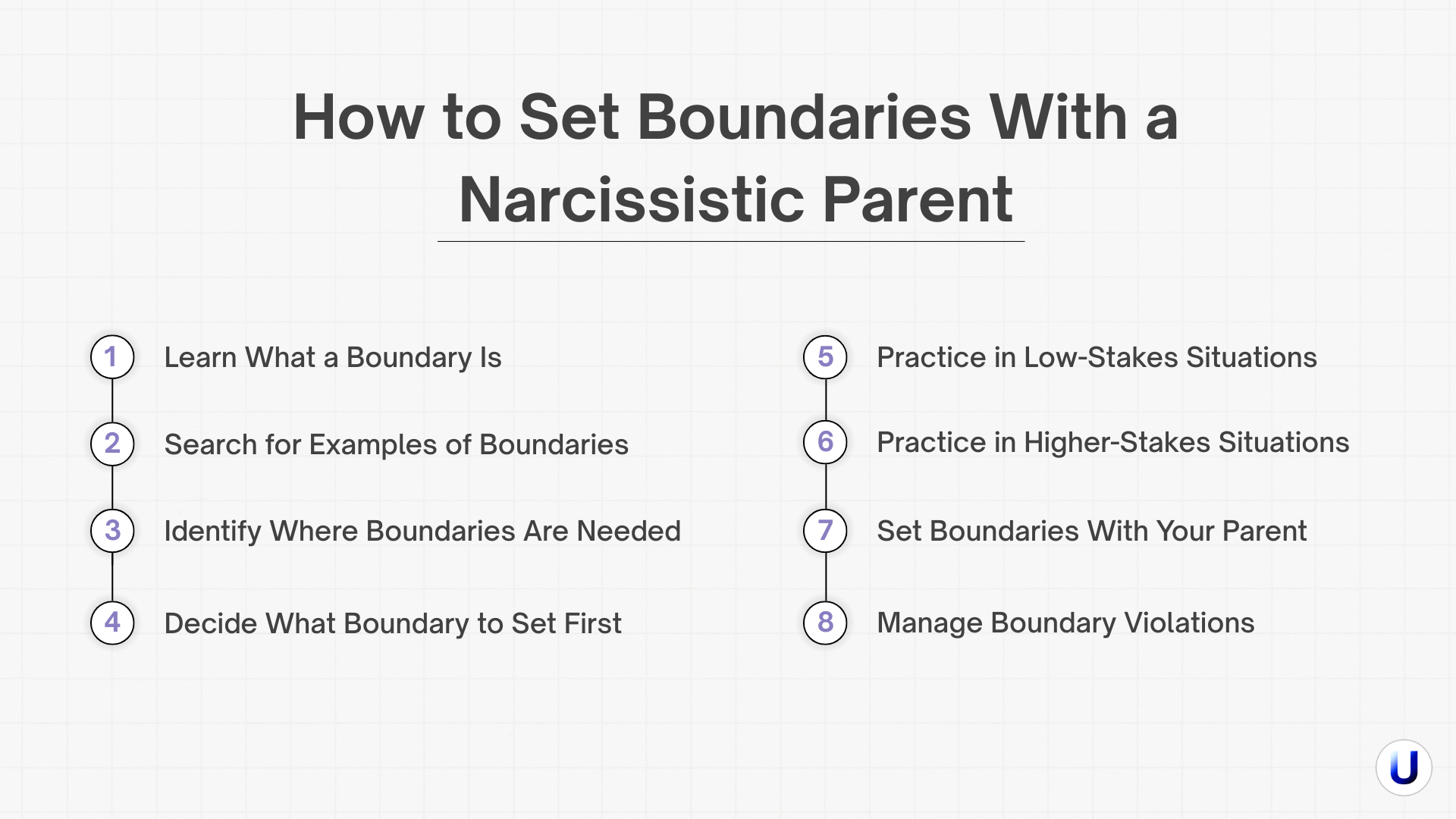
41 pages of notes later, I discovered the best boundary setters follow an eight-step process – and this episode will walk you through each one.
If we’re just meeting — my name is Juliana Akin. I’m a founder of Unfilteredd, and we help you overcome the effects of narcissistic abuse so you can heal and move forward with your life.
Step 1: Learn What a Boundary Is
The first step is to learn what a boundary is.
We define it as a personal rule you set to protect your physical, emotional, mental, sexual, or financial well-being.
For example:
- “I don’t answer work calls or texts after 8 PM”
- “I need 24 hours notice before visitors come over”
- “I won’t pretend to like activities I hate just to fit in”
Step 2: Search for Examples of Boundaries
The second step is to search for examples of boundaries in your day-to-day life.
For example, you might notice:
- Your landlord who only communicates through email
- A neighbor who won’t accept packages for other people
- A friend who never posts photos of their kids on social media.
Step 3: Identify Where Boundaries Are Needed
The third step is to identify where boundaries are needed with your parent.
One way to do this is to think about interactions that leave you feeling drained, frustrated, tense, overwhelmed, or out of balance — and ask yourself why.

Once you’ve identified a reason, try coming up with a list of boundaries you could potentially set in those specific situations.
If you feel stuck or unsure — and don’t have access to a mental health professional — you can open up a tool like Gemini, Claude, or ChatGPT and use a simple prompt like:
“[insert the situation] feels [insert feeling] because [insert reason]. Can I have a list of boundaries that could help me here?”
For example:
“Conversations with my mom feel stressful because they always turn into arguments about politics. Can I have a list of boundaries that could help me here?”
And it will give you a great list of boundaries you could potentially set.
Step 4: Decide What Boundary to Set First
The fourth step is to decide what boundary you might want to set first.
For example:
- “I’ll limit phone calls to 20 minutes.”
- “I won’t attend family holidays or gatherings anymore.”
- “I won’t discuss my dating life, marriage, or future plans.”
If you’re not sure what to pick, go back to the list you created in the third step and ask:
“Which of these boundaries would have the greatest positive impact on my life?”
And choose the one that pops out the most.
The key word for this fourth step is “might” — because you’re not setting these boundaries yet.
Boundaries, especially for children of narcissistic parents, are a big deal.
They can trigger a lot of confusing or painful thoughts, feelings, and emotions.

So it’s always a good idea to get a few practice reps in — with smaller, low-stakes situations — before tackling the big ones.
Step 5: Practice in Low-Stakes Situations
The fifth step is to practice setting boundaries in low-stakes situations.
A low-stakes situation is one where:
- The emotional risk is low
- The consequences are manageable
- The person involved isn’t likely to push back hard
- You feel relatively safe practicing the boundary
For example, if your boundary is “I won’t attend family holidays or gatherings anymore,” you could practice by declining invitations without over-explaining.
When coworkers invite you to after-work happy hours or office parties, practice saying “I can’t make it” without explaining that you’re busy, tired, or have other plans.

Step 6: Practice in Higher-Stakes Situations
The sixth step is to practice setting boundaries in slightly higher-stakes situations.
For example, once you feel comfortable declining invitations from colleagues, maybe practice with close friends when they invite you to their birthday parties or dinner plans.
And you just keep taking tiny steps up the ladder of difficulty because…
The goal of this step is to get more and more comfortable setting boundaries in higher and higher stakes situations, so when you try with your parent, it will feel more comfortable than if you were setting a boundary for the very first time.

Step 7: Set Boundaries With Your Parent
The seventh step is to start setting boundaries with your narcissistic parent.
But here’s the catch: they probably aren’t going to respect them.
This is because narcissistic parents don’t view their child as a separate person.
They view them as an extension of themselves.
It’s a lot like your relationship with your TV.
If one day your TV suddenly said, “I’m setting a boundary – no movies after 5 PM,” you’d probably think, “Are you out of your mind? You’re MY TV, play the movie.”

That’s exactly how a narcissistic parent sees you.
When you set a boundary, their brain computes it as: “My TV is telling ME when I can use it.”
So they often do everything in their power to cross it.
We’re talking things like:
- Love bombing
- Gaslighting
- Guilt-tripping
- Making threats
- Flying into a rage.
- Even giving you the silent treatment.
They’ll cycle through these tactics like someone frantically pressing buttons on a broken remote, trying to get their “TV” to work properly again.
But that’s okay.
Because boundaries aren’t about getting them to see you as a separate person (they can’t).
They’re about getting YOU to ACT like the separate person you ACTUALLY are.
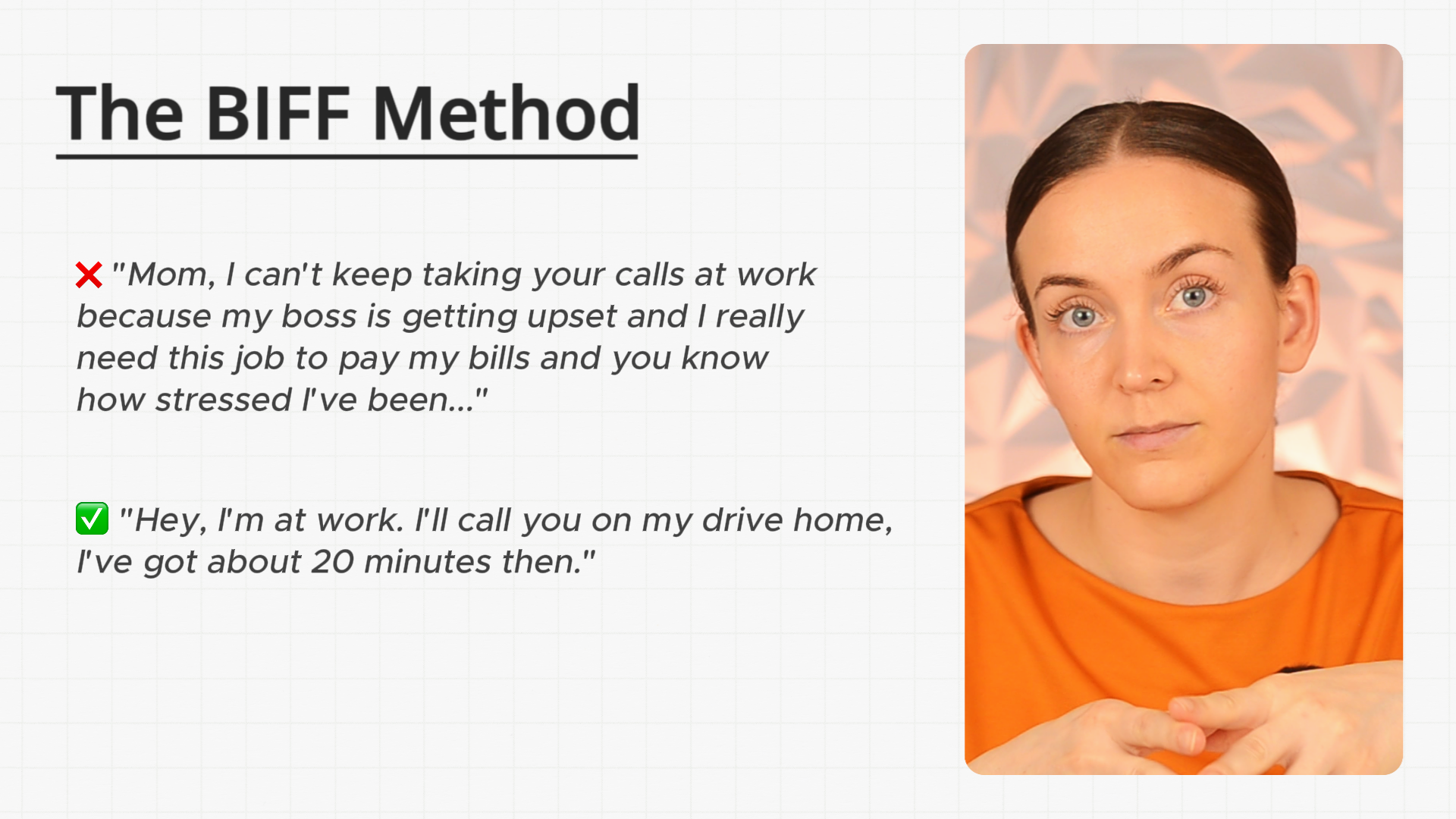
To do this, we recommend using the B.I.F.F. Method to communicate your boundaries.
B.I.F.F. stands for Brief, Informative, Friendly, and Firm.
This method is like kryptonite to narcissistic people because it gives them nothing to grab onto.
No emotions to manipulate. No long explanations to debate. No vulnerabilities to exploit.
Here’s how it works:
Brief – Keep your responses short.
Informative – Stick to the facts and avoid sharing anything personal.
Friendly – This doesn’t mean being best friends with them. It just means staying cool, calm, collected, and respectful, even if they’re being rude and/or manipulative.
Firm – Communicate clearly and assertively.
For example, instead of: “Mom, I can’t keep taking your calls at work because my boss is getting upset and I really need this job to pay my bills and you know how stressed I’ve been…”
You’d say: “Hey, I’m at work. I’ll call you on my drive home, I’ve got about 20 minutes then.”
Step 8: Manage Boundary Violations
The eighth step is to manage boundary violations.
As I mentioned before, your narcissistic parent will probably violate your boundaries.
There’s nothing you can do to change this.
So, you’re going to have to distance yourself as much as possible.
The thought of doing this might be terrifying, because it feels like you only have two options — you either cut them off completely, or you keep the relationship going.
But that’s not true.
There’s actually a lot of little steps in between that are available to you.
You can start with things like:
- Taking longer to respond to texts
- Muting them on social media
- Sharing less about your personal life
- Visiting less frequently
- Letting calls go to voicemail
- Skipping some family gatherings
- Bringing a friend as a buffer when you visit
You can take these small steps without committing to something big.
Think of it like dipping your toe in the water—instead of diving in head first.

Take a tiny step, see how it feels, and then adjust.
That’s how you begin setting boundaries with a narcissistic parent.
Final Thoughts
What we talked about today is an extremely effective approach to setting boundaries with a narcissistic parent, but for most people, the work doesn’t stop here.
If you want to set and maintain boundaries consistently, not just with your parent but with other people in your life too, there’s a lot of internal work that needs to be done.
So in this next episode, I’m going to help you get started with this by walking you through a complete guide to reparenting.
If you haven’t heard of this term before, it’s the process of becoming the safe, loving, supportive adult you didn’t have as a child, and it’s how children of narcissistic parents heal.
Read Now: How to Reparent Yourself After Being Raised By a Narcissist
And just a heads up, the beginning of the reparenting episode is a shorter version of what we talked about today, so feel free to skip it to get right into the internal work.
Thank you for reading today’s episode the Unfilteredd: Narcissistic Families podcast.
If this was helpful and you’d like to read the next one, please subscribe to our newsletter — we’ll let you know as soon as the next episode is released.
My name is Juliana Akin — your guide to overcoming the effects of narcissistic abuse — and I can’t wait to connect with you in a future episode.
Subscribe to Our Newsletter
We’ll send you new episodes of the Unfilteredd: Narcissistic Families podcast 1–2 times a week, along with updates and insights to help you heal and move forward with your life.
About the Author

Hi, it’s Juliana!
I’m a founder of Unfilteredd and we help you overcome the effects of narcissistic abuse so you can heal and move forward with your life.