
What exactly does a narcissist want in a relationship?
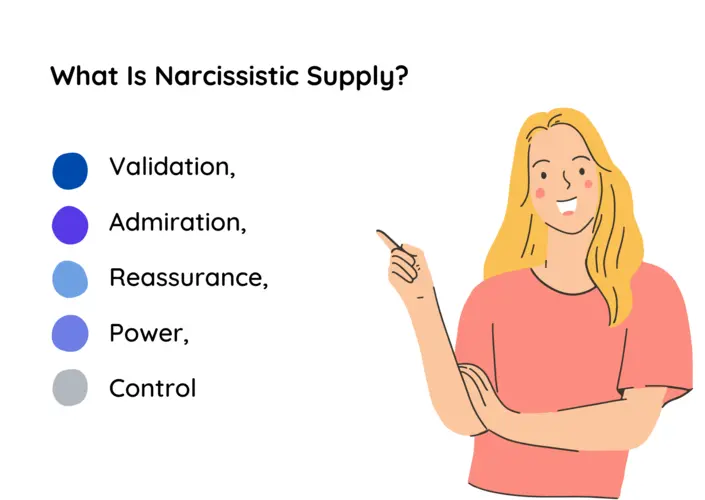
There are five things.
The first is validation.
They want you to constantly confirm that they are special, important, and perfect.
The second is admiration.
They want you to put them on a pedestal and worship them.
The third is reassurance.
They want you to constantly prove that you love them and will never leave them.
The fourth is power.
They want to be in charge of the relationship.
The fifth is control.
They want to micromanage every aspect of your life.
These five things have a name: they’re called “narcissistic supply.”
And they’re the most important part of a narcissist’s existence because their deepest, most protected secret is that underneath it all, they feel:
- unlovable
- unwanted
- inadequate
- worthless
- weak
These feelings usually come from traumatic early childhood experiences.
And those same experiences taught them that getting validation, admiration, reassurance, power, and control from others is the only way to feel safe, secure, and worthy.
It’s really sad, and might make you think:
“I should just give them as much narcissistic supply as I can so they stop hurting.”
But it doesn’t work like that because those feelings of being unlovable, unwanted, inadequate, worthless, and weak are still there, and they aren’t going anywhere.
They’ve spent their entire life constructing a false sense of self out of narcissistic supply to suppress the painful feelings they have about themselves.
And they’ve done such a good job that they’ve convinced themselves that those feelings don’t even exist.
So they’re stuck in this cycle of desperately trying to fill their bucket with supply, but it never being enough because the feelings they’ve suppressed keep poking holes in the bottom.
And they can’t see the holes because seeing them would mean acknowledging those feelings exist. And doing that would destroy the sense of self they’ve spent their entire life building.
So instead of fixing the holes, they demand more supply. And this leaves you feeling like you’re not good enough or that you didn’t try hard enough to make the relationship work.
Letting go of those beliefs can be really hard — and if you’re anything like us, it takes more than just hearing they’re not true to actually let go. You need to see it and feel it for yourself.
To help you do this, I want to share an exercise our community calls the “Logic Emotion Cup.”
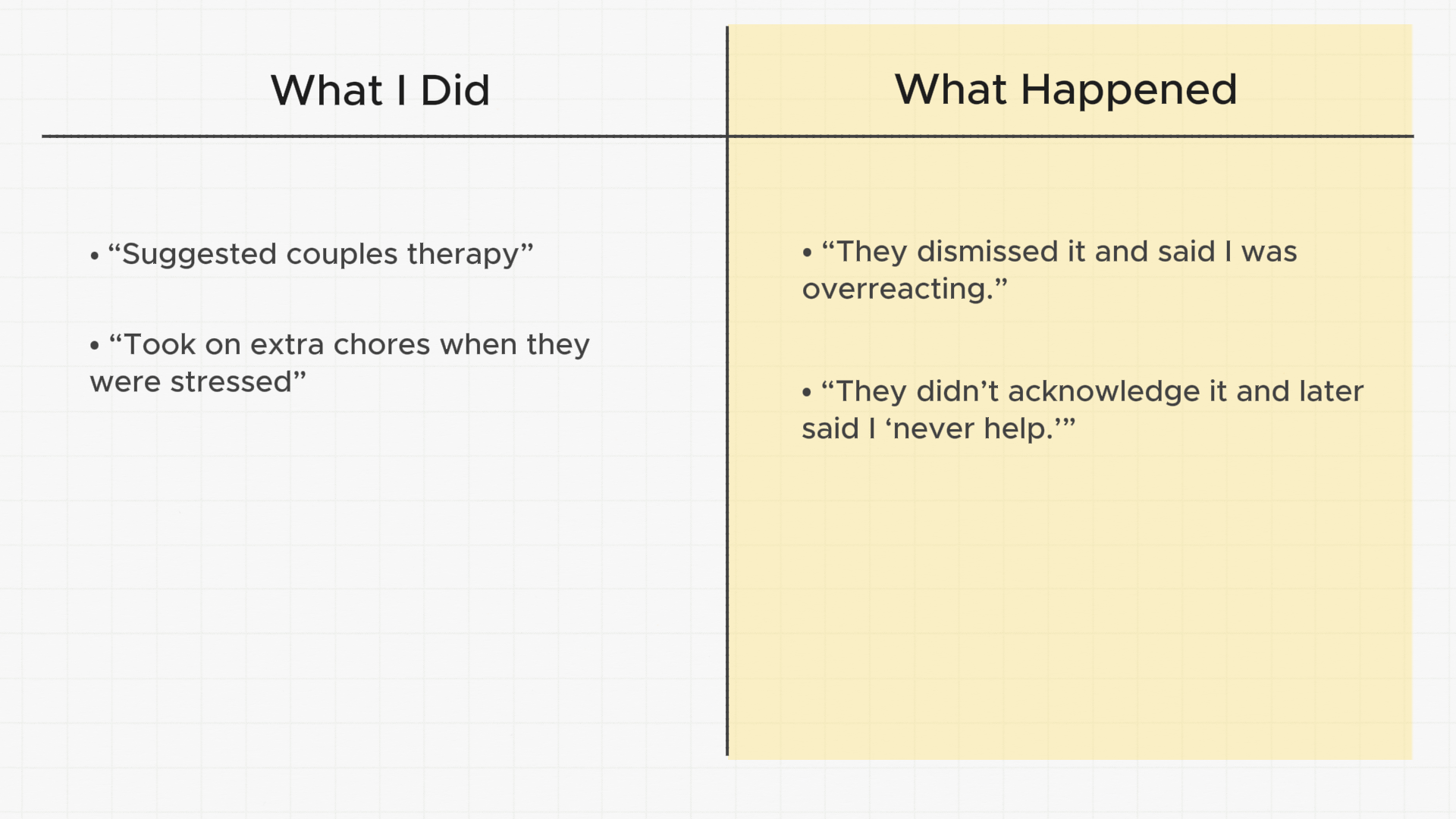
First, grab a piece of paper and make two columns.
Label the left side “What I Did” — meaning the things you did to try to make the relationship work.
And label the right side “What Happened” — meaning their response to your efforts.
Then, fill it out as much as you can.
For example:
- What I Did: “Suggested couples therapy”
What Happened: “They dismissed it and said I was overreacting.” - What I Did: “Took on extra chores when they were stressed”
What Happened: “They didn’t acknowledge it and later said I ‘never help.’”
Next, get a plastic cup and draw a line near the top.
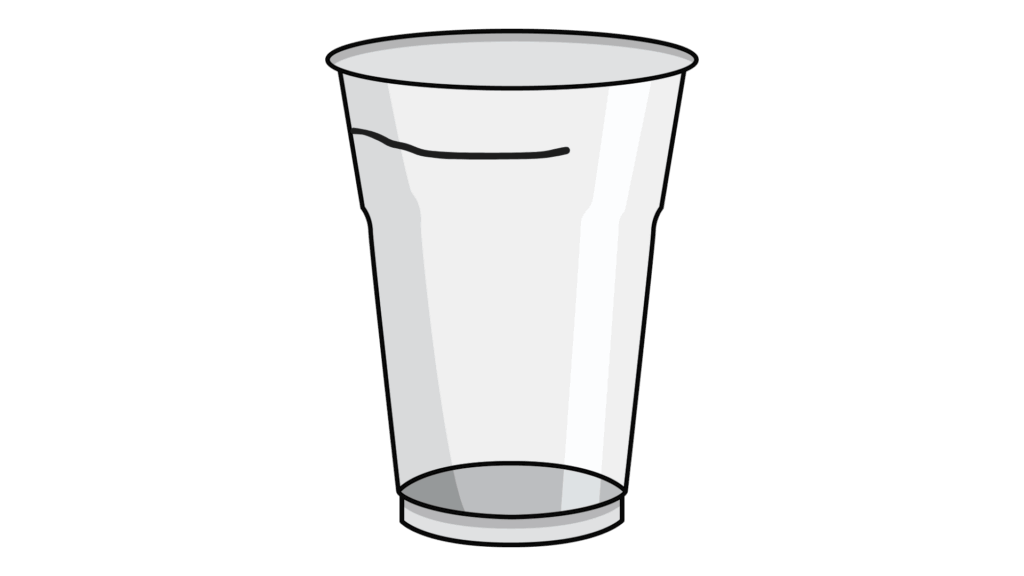
Poke a few small holes in the bottom.
Fill the cup with water up to the line, and see how long you can keep it there.
You can’t plug the holes.
The only thing you can do is pour more water in.
Pay attention to how messy it gets. How exhausting it is. How much water it takes.
Imagine doing this 24/7 for the rest of your life. Imagine what it would cost you.
This is what being in a relationship with a narcissist is like.
And this is why the “I wasn’t good enough,” or “I didn’t try hard enough” narrative needs to end today.
The first part of this exercise speaks to your logical side.
It moves the narrative out of your head and onto paper so you can see, in concrete terms, that the problem wasn’t you or your lack of effort.
The second part speaks to your emotional side.
It gives you a physical, gut-level experience of how impossible it is to fill something that can’t hold what you give.
And when these two sides come together, the “I wasn’t good enough” or “I didn’t try hard enough” narrative begins to fall apart.
Final Thoughts
Thank you for reading today’s episode of the Unfilteredd: Narcissistic Partners podcast.
If this was helpful and you’d like to read the next one, please subscribe to our newsletter — we’ll let you know as soon as the next episode is released.
My name is Juliana Akin, your guide to overcoming the effects of narcissistic abuse — and I can’t wait to connect with you in a future episode.
Latest Posts
Subscribe to Our Newsletter
We’ll send you new episodes of the Unfilteredd: Narcissistic Partners podcast 1–2 times a week, along with updates and insights to help you heal and move forward with your life.
About the Author

Hi, it’s Juliana!
I’m a founder of Unfilteredd and we help you overcome the effects of narcissistic abuse so you can heal and move forward with your life.