How to Break a Trauma Bond with a Narcissist
Welcome to our course, “How to Break a Trauma Bond with a Narcissist.”
In this course, Dr. Sara Spowart will cover the following:
We strongly recommend you watch the entire interview (see below), then move on to the resources we’ve created to help you implement the eleven strategies Dr. Sara mentions.
This is our recommendation because watching the interview will give you a profound understanding of trauma bonds and the strategies you can use to break them.
Thank you so much for allowing us to support you. We hope this course helps you make progress in your healing journey.
How to Break a Trauma Bond (11 Steps)
Step 1: Increase Your Awareness of Your Situation
Skip to 18:10 to watch Step 1. Ready to watch? Click here to jump to the video.
Writing Activity: “Seeing the Cycle”
Welcome to this writing activity, “Seeing the Cycle.”
This exercise aims to help you recognize, understand, and articulate the patterns in your relationship with the trauma-bonded individual.
Exploring and identifying these patterns is the first step in increasing your awareness.
1. Relationship Outline
2. Emotional Highs and Lows
3. Repeated Patterns
4. Power Dynamics
5. Moments of Realization
6. Mindfulness Break
Instruction:
7. Acknowledging the Cycle
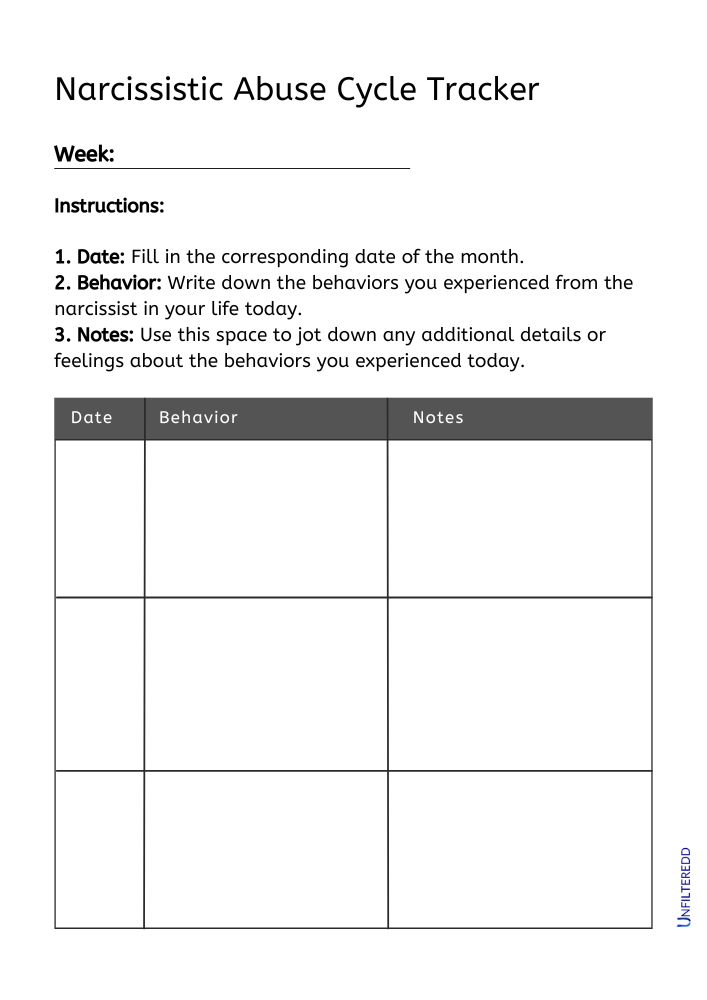
Narcissistic Abuse Cycle Tracker
Welcome to the “Narcissistic Abuse Cycle Tracker” tool.
This tool is designed to assist you in visually documenting and identifying recurring behaviors within your relationship.
Tracking these behaviors over time can shed light on patterns and cycles that might be difficult to see in day-to-day interactions.
Use this tracker consistently, and over time, the patterns will become clearer.
You can download and print out this tracker by clicking here.
Identify Your Supporters Checklist
Welcome to this evaluation activity, “Identifying Your Supporters.”
This checklist aims to help you assess the level of support you receive from the individuals in your life.
Understanding who truly supports you is essential, especially when navigating the challenges of a trauma bond.
Through this activity, you will gain insight into the quality of the relationships around you, allowing you to surround yourself with positive reinforcement and understanding.
Rate each item on a scale from 0 to 2, where:
Questions:
After you’ve scored each item, add up your scores for a total of 20. A higher score suggests the individual is more supportive:
Remember, this isn’t science. It’s just a checklist. So please take the scores you get with a grain of salt.
Step 2: Maintain Awareness of Your Situation
Skip to 24:37 to watch Step 2. Ready to watch? Click here to jump to the video.
Writing Activity: “Maintaining Awareness”
Welcome to this writing activity, “Maintaining Awareness.”
Our mission in this exercise is straightforward: to help you consistently recognize and confront the reality of your situation, using guidance from Dr. Sara Spowart. Revisiting and reinforcing your awareness is crucial in navigating and breaking trauma bonds.
1. Revisit and Reflect
2. Daily Documenting
3. Consistent Check-ins
Step 3: Identify Your Core Wounds
Skip to 35:28 to watch Step 3. Ready to watch? Click here to jump to the video.
Journaling Activity: “Identifying Your Core Wounds”
Welcome to this reflective journey, “Identifying Your Core Wounds.”
This activity aims to illuminate and understand the deep-seated wounds and beliefs that might be holding you in the grip of a trauma bond.
It’s about introspection, healing, and gaining clarity.
As you navigate through each question, remember: this is a self-discovery process, and there’s no rush.
Before you start, please take a moment to remind yourself that this activity is about understanding your core wounds, not blaming yourself for having them.
1. Unfulfilled Needs
2. Toxic Beliefs
Final Thought:
Step 4: Work on Healing Your Core Wounds
Skip to 39:40 to watch Step 4. Ready to watch? Click here to jump to the video.
Writing Activity: “How Can You Build Yourself Up?”
Welcome to this writing activity, “How Can You Build Yourself Up?”
The goal here is simple: to help you identify things you can do to feel stronger, happier, and more confident in yourself. Take your time with each question, and let’s get started!
1. What Makes You Feel Good About Yourself?
2. What Are You Curious About?
3. How Do You Like to Move?
4. What’s Your Hidden Dream?
5. What’s the Smallest Step You Can Take?
6. What Words Lift You Up?
7. Who Are Your Supporters?
S.M.A.R.T. Goals Guide: Your Path to Healing
Welcome to this goal-setting activity.
The objective is straightforward: to guide you in taking small, manageable steps toward breaking the trauma bond.
We’ll follow the S.M.A.R.T. goal-setting framework, ensuring your goal is Specific, Measurable, Achievable, Relevant, and Time-bound.
Step 1: Specific (What’s the Goal?)
Step 2: Measurable (Can You Track It?)
Step 3: Achievable (Is It Realistic?)
Step 4: Relevant (Why Does It Matter?)
Step 5: Time-bound (When Will You Get There?)
Step 5: Identify Areas for Improvement in Your Life Separate from the Narcissist
Skip to 46:40 to watch Step 5. Ready to watch? Click here to jump to the video.
Writing Activity: “Improving Areas of Your Life Separate from the Narcissist”
Welcome to this writing activity, designed to help you identify areas in your life that you’d like to improve, entirely separate from the narcissist.
The goal here is to shift the focus back onto you and your growth so that your life doesn’t revolve around the narcissist.
Prompt 1: What Areas Can You Improve?
Prompt 2: Why These Areas?
Prompt 3: How Will You Make Time for These Areas?
Prompt 4: First Steps
Prompt 5: Support System
Step 6 & 7: Identify Baby Steps You Can Take To Improve Your Life & Implement the Identified Steps into Your Life
Skip to 47:28 to watch Step 6 & 7. Ready to watch? Click here to jump to the video.
Goal Setting Activity: Identifying and Implementing Baby Steps
Welcome to the first part of this goal-setting activity.
The purpose of this exercise is to help you identify small, manageable steps you can take to improve your life.
We’re focusing on baby steps because they are easier to manage, less likely to draw attention from the narcissist, and effective in gradually building you up.
Part 1: Identifying
Step 1: Specific (What’s the Goal?)
Step 2: Measurable (Can You Track It?)
Step 3: Achievable (Is It Realistic?)
Step 4: Relevant (Why Does It Matter?)
Step 5: Time-bound (When Will You Get There?)
Part 2: Implementing
Welcome to the second part of this goal-setting activity. Now that you’ve identified your baby steps in the previous exercise, the goal is to help you implement those steps. Remember, you want to try to implement these changes in a manageable, unnoticeable way to the narcissist and beneficial for your healing journey.
Step 1: Set a Specific Time
Step 2: Prepare Your Gear
Step 3: Tracking Your Progress
Step 4: Accountability
Step 5: Dealing with Obstacles
Step 6: Time Review
Step 7: Celebrate Small Wins
Step 8: Identify the Hooks the Narcissist Uses to Pull You Back In
Skip to 50:38 to watch Step. Ready to watch? Click here to jump to the video.
Writing Activity: “Identifying the Narcissist’s Hooks”
Welcome to “Identifying the Narcissist’s Hooks.”
This activity aims to help you clearly identify the hooks that a narcissist uses to pull you back in and the tactics that have failed to work on you.
By recognizing both, you can better understand the strategies and patterns the narcissist is employing.
This level of awareness is crucial in mitigating their influence over you.
Instructions
Step 9: Commit to Being Aware of These Hooks and Track How the Narcissist Uses Them
Skip to 59:16 to watch Step 9. Ready to watch? Click here to jump to the video.
Writing Activity: “Committing to Awareness and Tracking Hooks”
Welcome to “Committing to Awareness and Tracking Hooks.”
The goal is simple: keep track of how the narcissist tries to pull you back every day. By doing this daily, you’ll start seeing their patterns, making it easier to protect yourself.
Instructions
Step 10: Add More Positive Things to Your Life
Skip to 01:03:35 to watch Step 10. Ready to watch? Click here to jump to the video.
Goal Setting Activity Identifying and Implementing Baby Steps to Add Positive Things to Your Life
Part 1:
Welcome to the first part of this goal-setting activity.
The objective here is simple: identify small, manageable ways to add positive things into your life. Doing this will help counter the negative effects of the narcissistic relationship.
Instructions for Identifying Baby Steps
Step 1: Specific (What’s the Goal?)
Step 2: Measurable (Can You Track It?)
Step 3: Achievable (Is It Realistic?)
Step 4: Relevant (Why Does It Matter?)
Step 5: Time-bound (When Will You Get There?)
Part 2:
Welcome to the second part of this goal-setting activity.
You’ve figured out what positive things you want to add to your life.
Now, it’s time to put those plans into action. This guide will help you make those positive additions a daily reality.
Implementation Guide
Step 1: What’s the Plan? (Specific)
Step 2: How Will You Keep Track? (Measurable)
Step 3: Are You Ready? (Achievable)
Step 4: Why Keep Going? (Relevant)
Step 5: When Will You Check In? (Time-bound)
Step 11: Limit the Contact as Much as Possible
Skip to 01:04:00 to watch Step 11. Ready to watch? Click here to jump to the video.
The final step from our interview with Dr. Sara was to limit your contact with the narcissist as much as possible.
In a perfect world, this would mean using the No Contact Method. However, this strategy isn’t always an option for various reasons, such as:
If the No Contact Method isn’t an option, your next best bet is the Low Contact Method.
Here is the timestamp for Dr. Sara’s explanation of this eleventh step:
Skip to 01:04:00 to watch Step 11. Click here to jump to the video.
We highly recommend you watch this part of the interview because it will help you understand why limiting contact with the narcissist as much as possible is so important.
In addition, here’s a list of resources we believe will help you through this eleventh step and answer any question you may have about limiting contact with the narcissist.
If You’re Going No Contact:
If You’re Going Low Contact:
“This journey of healing from narcissistic abuse is far from easy and filled with lengthy, challenging days. But every struggle faced is a brave step towards deepening our understanding and compassion for ourselves, and it’s crucial to honor every bit of progress made. Let’s keep nurturing the hope and strength we have within ourselves and moving towards healing and self-love.” – Juliana Akin, Founder of Unfilteredd